
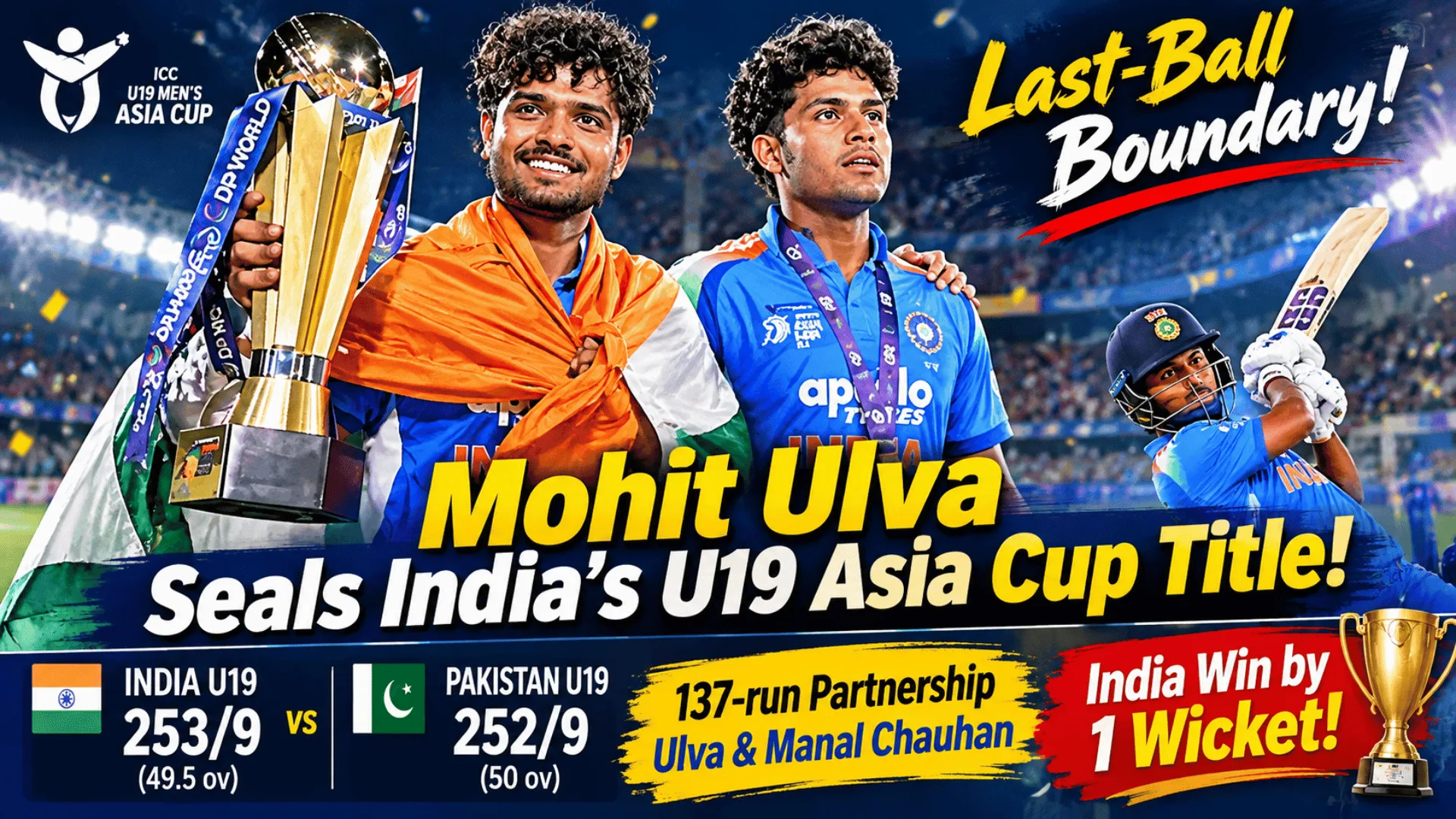
India's dramatic one-wicket victory over Pakistan in the Under-19 Asia Cup final remains a defining moment for the young players who delivered the unforgettable triumph. While Mohit Ulva became the centre of attention after striking the winning boundary off the final delivery, captain Lakshya Raichandani revealed how belief, teamwork and a remarkable team spirit helped India overcome a seemingly impossible situation.
India chased down Pakistan's imposing target of 338 in Muscat, completing the victory with just one wicket remaining. The contest appeared to be slipping away when India were reduced to 252 for eight, but a crucial ninth-wicket partnership between Manal Chauhan and Ulva brought the team back into contention.
With three runs required from the final delivery, Ulva found the boundary to seal one of the most memorable India-Pakistan encounters in recent Under-19 cricket.
Mohit Ulva's Last-Ball Heroics: A Moment That Changed Everything
For 18-year-old Ulva, the winning shot felt almost unreal. Speaking after the final, the young all-rounder described the experience as a dream and expressed gratitude for being given the opportunity to decide such an important match.
He revealed that he had been waiting for the right delivery during the final over, confident that one well-timed boundary could complete the chase. When the bowler delivered a short ball outside off stump, Ulva stepped out of his crease, created room and guided the ball into the gap between extra cover and long-off.
Rather than attempting an unnecessarily powerful shot, he focused on finding the open space in the field. The decision proved decisive as the ball raced away for four, triggering celebrations among the Indian players.
Ulva also explained that he had practised similar high-pressure situations regularly. As a lower-order batter, he often challenged himself in training by attempting scenarios such as scoring 100 runs in 10 overs with only three wickets remaining.
That preparation helped him remain composed when India needed a major contribution from its lower order.
The Partnership That Kept India's Hopes Alive
India's chase had started positively, with Raichandani and Aaryavir Sehwag putting together a 95-run opening partnership. Raichandani also contributed to a valuable stand with VK Vineeth, but a sudden collapse left India facing a difficult finish.
At 252 for eight in the 42nd over, India still needed 86 runs from the final eight overs. The situation demanded exceptional composure from Chauhan and Ulva, who responded with a 57-run partnership from just 35 deliveries.
Ulva said the two batters agreed that at least one of them had to remain at the crease until the final ball. Their approach was straightforward: watch the ball carefully, take calculated risks and avoid losing unnecessary wickets.
He also credited No. 11 batter Chigurupati Venkata for encouraging him to stay calm. Venkata assured Ulva that he would look for singles rather than waste deliveries, allowing the more established batter to retain the strike whenever possible.
Ulva had confidence in the team's batting depth, pointing out that even Venkata had experience opening for his state side. That belief became particularly important during the closing stages of the chase.
Lakshya Raichandani Reveals the Dressing Room's Unshakable Belief
Captain Raichandani admitted that the victory had not fully sunk in even two days after the final. Having grown up listening to stories about historic India-Pakistan cricket encounters from his father and late childhood coach, he described the final as an experience that brought those stories to life.
Despite India's difficult position, Raichandani said he never lost faith in the lower-order batters. He explained that the entire squad had the ability to contribute with the bat, including players primarily selected for their bowling.
According to the captain, the team regularly worked on batting during practice sessions, which gave everyone confidence in their ability to handle difficult situations.
Raichandani also revealed an unusual moment from the tense closing overs. As Chauhan and Ulva fought to keep India in the contest, the entire squad remained in their seats, with nobody wanting to move.
Some players were praying, while others were quietly hoping for the winning result. Raichandani said Aaryavir Sehwag was chanting prayers as the team waited anxiously for the final outcome.
Their hopes were eventually rewarded when Ulva struck the decisive boundary.
Raichandani and Sehwag Formed the Foundation of India's Campaign
Although the final attracted attention because of the extraordinary finish, India's batting success throughout the tournament was built largely around the opening partnership between Raichandani and Sehwag.
The pair registered four partnerships of more than 50 runs in five innings, including two century stands. Their consistency gave India strong starts and helped establish the platform for the team's eventual title-winning campaign.
Sehwag finished as the tournament's leading run-scorer with 361 runs in five innings, including one century and three half-centuries. His performances earned him the Player of the Tournament award.
Raichandani also enjoyed an impressive campaign, scoring 243 runs at an average of 60.75, with three half-centuries.
The captain explained that their approach was based on playing conventional cricket, taking calculated risks and adjusting their scoring rate according to the match situation. He also praised Sehwag for converting promising starts into substantial scores after discussions with the coaching staff ahead of the competition.
Young Indian Players Respond to Celebration Debate
India's celebrations following the dramatic victory generated considerable discussion, with opinions divided over whether the players had shown excessive aggression.
Ulva defended the team's reaction, explaining that the celebrations were natural given the importance of an India-Pakistan final. He also pointed out that Pakistan had celebrated enthusiastically after winning their earlier group-stage encounter.
Raichandani offered a similar explanation, saying the celebrations had not been planned in advance. According to him, the players simply ran towards the pitch after the winning boundary, allowing their emotions to take over following the intense contest.
Both players emphasised the effort that had gone into winning the tournament and viewed the celebrations as a spontaneous expression of relief and happiness.
Mohit Ulva's Rise: From 2,000 Instagram Followers to National Attention
Ulva's winning performance quickly transformed his public profile. Before the final, he had approximately 2,000 followers on Instagram. Following his match-winning contribution, that number climbed beyond 40,000.
The youngster said he appreciated the messages and encouragement from cricket fans but preferred to avoid excessive attention. He mentioned that former India all-rounder Yuvraj Singh had shared a social media story about him, while former Pakistan fast bowler Shoaib Akhtar had also posted about his performance.
Despite the sudden attention, Ulva remained focused on improving his game. He travelled directly from Muscat to Indore after the final to join Saurashtra's senior team for the Syed Mushtaq Ali Trophy.
Interestingly, Ulva described himself primarily as a bowling all-rounder. He had limited batting opportunities during the Asia Cup because of India's strong batting line-up, appearing at the crease only twice before his extended innings in the final.
His immediate ambition is to establish himself in senior domestic cricket and make the most of every opportunity. While he hopes to attract interest from IPL franchises in the future, he acknowledged that consistent performances at the domestic level must come first.
Raichandani Dedicates Asia Cup Triumph to Late Childhood Coach
For Raichandani, the championship carried a deeply personal meaning beyond the cricketing achievement.
The India U19 captain dedicated the victory to his childhood coach, Abhishek Kumar, who passed away from a brain haemorrhage just one month before the final at the age of 39.
Raichandani spent much of his childhood away from his family in Haldwani, where Kumar guided his cricket development. He described the coach's sudden passing as devastating and said the Asia Cup triumph was a way of honouring the person who played such an important role in his journey.
The captain is now looking forward to continuing his progress in domestic cricket. Having already represented Uttarakhand in the Ranji Trophy, he hopes to earn opportunities in the Syed Mushtaq Ali Trophy and Vijay Hazare Trophy.
India U19's Asia Cup Victory Could Be the Beginning of Bigger Careers
The thrilling final against Pakistan provided a glimpse of the potential within India's next generation of cricketers. Raichandani and Sehwag established themselves as key batting contributors throughout the competition, while Ulva's last-ball heroics demonstrated the importance of lower-order depth and mental strength.
For Ulva, the immediate challenge is to establish himself in Saurashtra's senior side. Raichandani is equally focused on making progress through India's domestic structure rather than looking too far ahead.
Their ambitions remain grounded despite the sudden attention surrounding the Asia Cup victory. However, the unforgettable final has already given both players a significant moment in their young careers.
India's one-wicket win will be remembered for Ulva's final-ball boundary, but the triumph was built on the collective belief of a team that refused to surrender, even when the odds appeared firmly against them.