
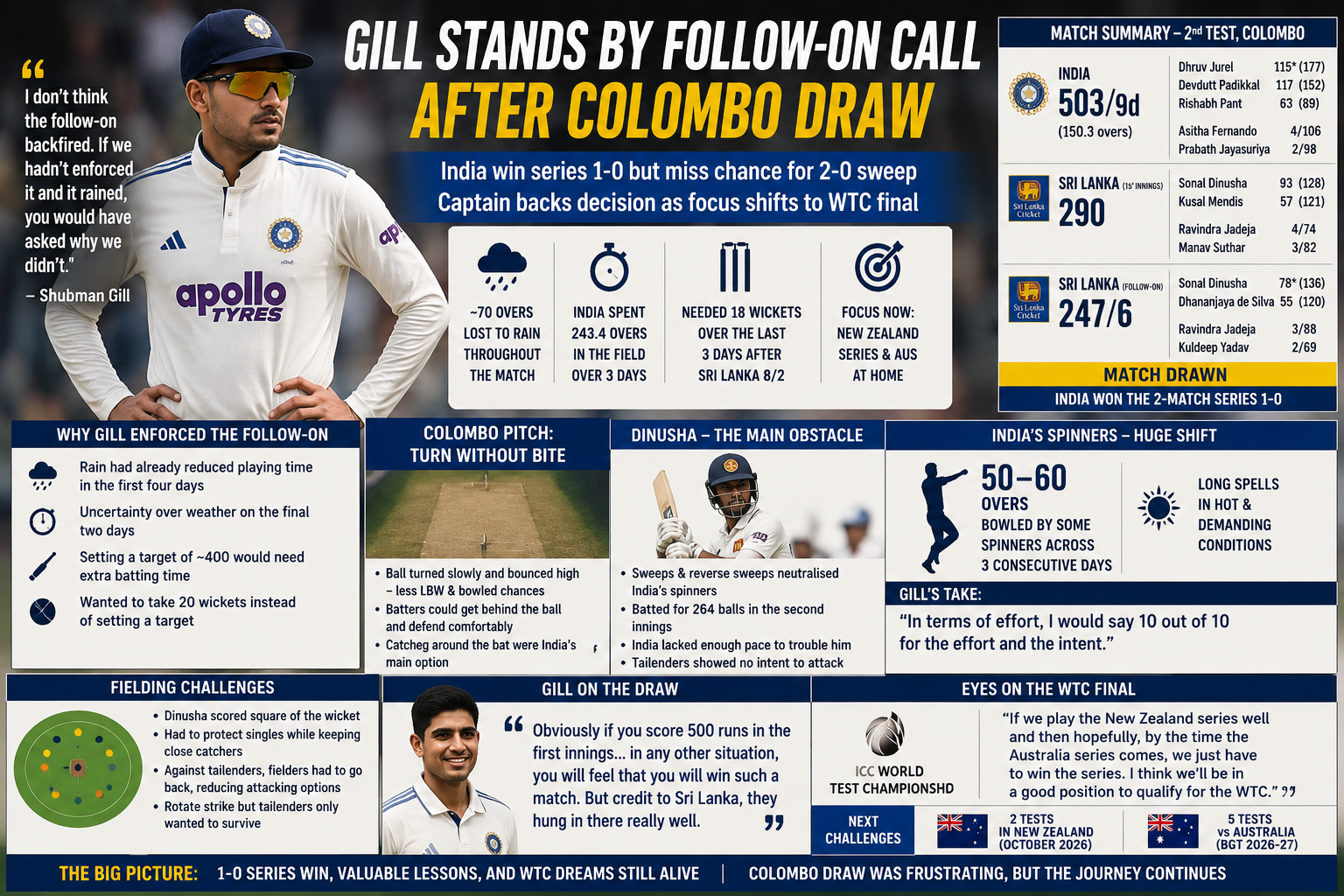
India may have secured a 1-0 series victory over Sri Lanka, but the drawn second Test in Colombo left captain Shubman Gill facing plenty of questions about his decision-making and India's missed opportunity to claim a 2-0 sweep.
India had appeared firmly in control after declaring on 503/9 and then reducing Sri Lanka to 8/2. They later enforced the follow-on after dismissing Sri Lanka for 290, but the hosts produced a remarkable resistance to save the Test.
Sonal Dinusha was at the heart of Sri Lanka's fightback, while the lower order provided crucial support as India spent 243.4 overs in the field without finding the final wickets required for victory.
Gill, however, remains convinced that enforcing the follow-on was the correct decision given the circumstances.
Gill: Follow-On Decision Did Not Backfire
The biggest talking point after the Colombo draw was India's decision to make Sri Lanka bat again rather than return to the crease and set a target.
India had already lost significant playing time to rain during the first four days. With uncertainty surrounding the weather on the final two days, Gill believed the follow-on offered India the best chance of forcing a result.
"I don't think the follow-on backfired."
Gill explained that India had to make the decision based on the information available at the time rather than what eventually happened.
India had spent more than 240 overs in the field, while approximately 70 overs had already been lost to rain during the match. The alternative would have been to bat for another session or two, establish a target around 400 and then hope there was sufficient time to bowl Sri Lanka out.
Instead, India chose to put Sri Lanka back in and chase the wickets immediately.
"If we hadn't enforced the follow-on and if it had rained, you would have asked again why we didn't enforce the follow-on," Gill said, stressing that hindsight could not be used to judge the decision.
Colombo Pitch Made Life Easier for Sri Lanka
The conditions at the Sinhalese Sports Club also played a major role in India's inability to complete the victory.
Although the pitch continued to offer turn, Gill explained that the nature of the turn became less threatening as the Test progressed.
The ball was turning slowly and bouncing relatively high, meaning two traditional methods of dismissing defensive batters — LBW and bowled — became much less effective.
"When the ball was turning, it was turning very slow and with bounce," Gill explained.
For defensive batters, this effectively left India relying heavily on catches around the bat, including at short leg, silly point and slip.
As the pitch slowed further, Sri Lanka's batters could simply get behind the ball and avoid taking unnecessary risks.
Gill felt this was particularly important because Sri Lanka were not attempting to score quickly. Their priority was simply to survive.
Sonal Dinusha Becomes India's Biggest Obstacle
The biggest individual obstacle for India was Sonal Dinusha, who produced an extraordinary performance across the two Tests.
After already troubling India in the series opener, Dinusha once again showed exceptional patience and control in Colombo.
He repeatedly used sweeps and reverse sweeps to counter India's spinners, while also defending solidly whenever India attacked the stumps.
India attempted several strategies, including placing multiple close-in fielders and using short-pitched bowling.
But neither approach produced the breakthrough India needed.
Gill admitted that India's bowlers struggled to generate sufficient pace from the Colombo surface.
"We thought we can get him with pace but there wasn't enough of it on the wicket," Gill explained.
Even Prasidh Krishna, bowling around the 135-140 kmph range, struggled to force Dinusha into a mistake.
Dinusha eventually batted for 264 balls in the second innings, playing a central role in Sri Lanka's successful resistance.
India's Spinners Put in a Huge Shift
Gill was unwilling to criticise his bowlers despite the disappointing result.
India's spinners were forced to work for long periods, with some bowling 50-60 overs across three consecutive days in hot and demanding conditions.
Gill gave his players full credit for their effort and intensity.
"In terms of effort, I would say 10 out of 10 for the effort and the intent," he said.
India had entered the Test with three specialist spinners, expecting the Colombo surface to become increasingly difficult for batting.
However, the pitch did not deteriorate in the way India had hoped.
Instead, the surface became slower and, despite visible turn, provided fewer opportunities to attack the stumps.
India created chances earlier in the Test, but once Sri Lanka's lower order settled in, the visitors found it increasingly difficult to force a breakthrough.
Field Placements Had to Change
Gill also explained the tactical challenges India faced against Dinusha and Sri Lanka's lower order.
Dinusha was particularly productive square of the wicket, making sweeps and reverse sweeps an important part of his scoring method.
India therefore had to place fielders in those areas, while simultaneously protecting against singles and maintaining close catchers.
The problem became even more complicated when Dinusha was batting with a tailender.
India attempted to rotate the strike and expose the lower-order batter, but Sri Lanka's tailenders showed little interest in attacking.
Instead, they concentrated on survival.
This forced Gill to gradually move his fielders back, reducing India's attacking options in the process.
Gill Admits the Draw Was Frustrating
Although Gill insisted the draw did not feel like a defeat, he admitted the result was disappointing given India's position in the match.
India had scored more than 500 in their first innings and reduced Sri Lanka to 8/2 early in the contest.
From there, India needed only 18 wickets over the remaining three days to secure victory.
"Obviously if you score 500 runs in the first innings... in any other situation, you will feel that you will win such a match," Gill said.
However, he also acknowledged that Sri Lanka deserved significant credit for their resistance.
For Gill, the match was therefore both frustrating and educational.
"It gets very frustrating," he admitted when discussing the questions surrounding his captaincy decisions.
Rather than dwelling on the outcome, Gill said he had to assess whether he had made the best decision with the information available at that moment.
His answer remained yes.
India Still Have WTC Final Ambitions
The Colombo draw cost India valuable World Test Championship (WTC) points and made their route to the final more difficult.
India ultimately won the two-Test series 1-0 after their victory in Galle, but the missed opportunity in Colombo means they have less room for error in the remainder of the WTC cycle.
Gill, however, remains confident that India can still reach the final.
Their next major challenge will be a two-Test series in New Zealand in October, followed by a five-Test home series against Australia in the Border-Gavaskar Trophy.
Gill believes strong performances in those assignments could put India back in a favourable position.
"If we play the New Zealand series well and then hopefully, by the time the Australia series comes, we just have to win the series, I think we'll be in a good position to qualify for the WTC," he said.
A Valuable Lesson for Gill and India
The Colombo Test ultimately demonstrated the unpredictable nature of Test cricket.
India dominated significant portions of the match, produced a huge first-innings total and created early pressure on Sri Lanka. Yet the combination of a slowing pitch, determined batting and lower-order resistance prevented them from converting that dominance into victory.
For Gill, the experience represents another important chapter in his development as Test captain.
He defended the follow-on decision, praised his players' effort and accepted that some tactical choices will always be judged differently after the result is known.
India leave Sri Lanka with a 1-0 series win, but also with valuable lessons ahead of two crucial WTC assignments.
For Gill and his team, the challenge now is to turn those lessons into results when the pressure increases against New Zealand and Australia.