
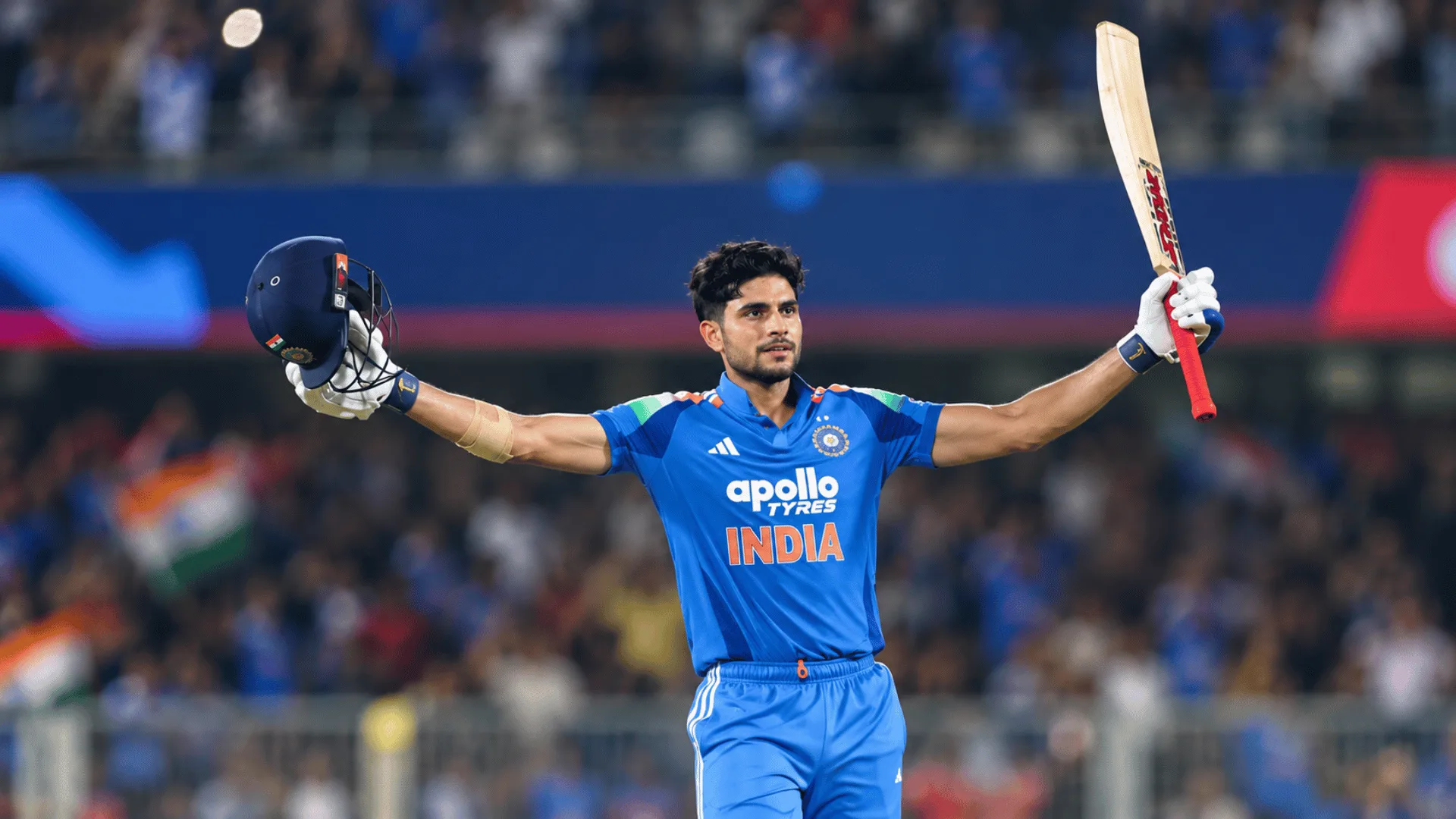
Shubman Gill produced one of the most remarkable innings in ODI cricket as India chased down 406 against West Indies in Guwahati, completing their highest successful run chase in the format with 39 balls to spare.
Gill smashed an unbeaten 223 off 133 balls, including the fastest double century in ODI history, while Rohit Sharma contributed a rapid century as India reached 406 for 2 in just 43.3 overs.
The extraordinary match produced a staggering 811 runs, with five batters scoring centuries for the first time in an ODI. While India's batting performance dominated the headlines, the extreme conditions also triggered a debate over the balance between bat and ball.
India batting coach Sitanshu Kotak and West Indies bowling coach Ravi Rampaul both acknowledged that there was very little assistance for the bowlers on the Guwahati surface.
India Complete Record 406-Run Chase
West Indies had already set an enormous target after reaching 405 for 7 from their 50 overs.
India, however, responded with an even more remarkable batting display.
Gill and Rohit Sharma took control from the opening overs, putting on 255 runs for the first wicket. Their partnership was India's second-highest opening stand in ODIs, narrowly behind the 258-run partnership between Sachin Tendulkar and Sourav Ganguly against Kenya in 2001.
It was also the highest partnership for any wicket by India during an ODI run chase and the highest against West Indies.
India crossed 200 in only 21.1 overs before reaching 300 in 29.1 overs, the fastest any team had reached those milestones in an ODI.
By the time India completed the chase, they had reached 406 for 2 in 43.3 overs, making it the second-highest successful chase in ODI history.
Only South Africa's famous pursuit of 435 against Australia at Johannesburg in 2006 remains higher.
Gill's Extraordinary 223 Not Out
Gill's innings was the defining performance of the night.
The India captain finished unbeaten on 223 from 133 deliveries, moving through the gears after a cautious start and eventually taking complete control of the West Indies attack.
His double century came from just 117 balls, making it the fastest 200 in ODI cricket and surpassing the previous record of 126 balls set by Ishan Kishan against Bangladesh.
Gill's 223 was also the third-highest individual score in ODI cricket, behind Rohit Sharma's 264 and Martin Guptill's unbeaten 237.
The performance carried additional significance because Gill became only the second batter to score a double century while chasing in ODI cricket, following Glenn Maxwell's unbeaten 201 against Afghanistan at the 2023 World Cup.
Gill also became the first captain to score double centuries in both Test and ODI cricket. He had previously made 269 against England in Birmingham in Test cricket.
His unbeaten 223 is also the highest individual score recorded in a List A run chase.
Rohit Sharma Reaches Another ODI Milestone
Gill's record-breaking night was matched by another major achievement from Rohit Sharma.
The India opener scored 101 from 72 balls, reaching his 35th ODI century and becoming only the third Indian batter after Sachin Tendulkar and Virat Kohli to cross 12,000 ODI runs.
Rohit reached the milestone in 282 innings, making him the second-fastest batter to 12,000 ODI runs after Kohli, who achieved the mark in 242 innings.
His century also helped India establish the platform for the record chase before Gill accelerated through the middle overs.
West Indies' Batters Also Made History
The extraordinary run-fest began with West Indies putting India under immense pressure.
Three West Indies batters scored centuries in the same innings.
John Campbell made 101 from 68 balls, Shai Hope scored 104 from 94 deliveries, while Amir Jangoo produced the fastest of the three centuries with 114.
Campbell and Hope added 110 runs for the second wicket before Hope later combined with Jangoo for a spectacular 182-run partnership.
Hope anchored the innings while Jangoo attacked aggressively, turning the partnership into one of the most important phases of the match.
Jangoo eventually reached his century from 70 balls, while Hope completed his hundred from 94.
West Indies finished on 405 for 7, their highest ODI total, surpassing their previous best of 389 against England in 2019.
Despite producing three individual centuries, however, they became the first side to lose an ODI after three of their batters had scored hundreds in the same innings.
Five Centuries in One ODI
The match created another remarkable statistical landmark.
Five batters — Campbell, Hope, Jangoo, Rohit and Gill — reached three figures during the game.
It was the first time five batters had scored centuries in the same ODI.
The previous record was four centuries in an ODI, a feat that had occurred in matches involving Pakistan and Australia in 1998, India and Australia in 2013, and Sri Lanka and Pakistan in 2023.
The Guwahati match therefore combined several rare batting achievements in a single contest.
Kuldeep Yadav Reaches 200 ODI Wickets
While the batsmen dominated the scoreboard, Kuldeep Yadav quietly reached another significant milestone.
The left-arm wrist-spinner claimed his 200th ODI wicket when he dismissed Keemo Paul late in the West Indies innings.
Kuldeep reached the milestone in 123 ODIs, becoming the second-fastest Indian bowler to 200 ODI wickets after Mohammed Shami.
He took 2 for 65 in the match and became the first left-arm wrist-spinner to reach 200 wickets in ODI cricket.
His milestone was particularly notable given the conditions, which offered very little assistance to spinners.
Guwahati Pitch Raises Questions About Bat-Ball Balance
The extraordinary scoring also led to immediate discussion about whether modern ODI cricket is becoming too heavily weighted toward batting.
India head coach Gautam Gambhir described the contest as being overwhelmingly favorable to batters, while batting coach Sitanshu Kotak said there was little for the bowlers to work with.
Kotak suggested that a more balanced ODI surface would ideally allow teams to score around 300 to 320 while still forcing the chasing side to work hard.
He also pointed to the fast outfield, where boundaries could quickly turn into additional 20, 30 or 40 runs.
However, Kotak stopped short of blaming the pitch or the curators.
He argued that producing a perfect cricket surface is extremely difficult because a curator cannot guarantee exactly how a pitch will behave once a match begins. A surface intended to produce a 250- or 300-run contest could unexpectedly offer excessive seam or spin and result in a much lower score.
West Indies Bowling Coach Shares Similar Concerns
Ravi Rampaul offered a similar assessment from the West Indies camp.
He acknowledged that modern cricket is increasingly being played on flat pitches, but described the Guwahati surface as even more favorable to batting because it provided little assistance to either fast bowlers or spinners.
For bowlers, the challenge was clear: when the pitch offers almost no movement and the outfield is quick, there are few opportunities to build pressure.
West Indies eventually managed only two wickets during India's chase, with Shamar Joseph and Jayden Seales among the bowlers to claim a dismissal.
811 Runs Highlight the Evolution of ODI Batting
The combined score of 811 runs made the Guwahati ODI one of the highest-scoring matches in the history of the format.
It was the fourth time an ODI had produced more than 800 runs, while the highest aggregate remains the 872 runs scored during the famous South Africa-Australia match at Johannesburg in 2006.
Kotak suggested that the evolution of batting itself should also be considered when discussing huge totals.
He compared the modern game with earlier eras, noting how a score around 180 was once considered substantial in a 60-over World Cup match, whereas totals approaching or exceeding 400 can now be chased successfully.
According to Kotak, the rise in batting standards is not necessarily explained by pitch conditions alone.
India Look Ahead to Different Conditions
The Guwahati surface may have been extremely favorable to batting, but India are expected to face very different challenges in their upcoming schedule.
Kotak pointed to India's future matches in New Zealand and preparations for the World Cup in Africa, emphasizing that the team must be ready for a variety of surfaces.
He suggested that modern ODI pitches do not necessarily need to be low-scoring or difficult to bat on. Instead, a surface producing somewhere around 300 to 350 runs while offering a genuine contest between bat and ball could provide a more balanced environment.
For India, the challenge will be ensuring that their dominant batting performances on home pitches do not become their only preparation for major tournaments.
Final Result
West Indies 405/7 in 50 oversAmir Jangoo 114, Shai Hope 104, John Campbell 101Kuldeep Yadav 2/65, Ravindra Jadeja 2/75, Gurnoor Brar 2/96
India 406/2 in 43.3 oversShubman Gill 223*, Rohit Sharma 101Shamar Joseph 1/52, Jayden Seales 1/78
India won by 8 wickets
The victory gave India an unassailable 2-0 lead in the three-match ODI series.
A Night Dominated by Batting History
India's record chase will be remembered primarily for Gill's extraordinary unbeaten 223 and Rohit's century, but the match was far bigger than one individual performance.
West Indies produced their highest ODI total and three centuries, India responded with two more hundreds, five batters reached three figures for the first time in an ODI, and more than 800 runs were scored in a single match.
At the same time, the performances reignited an important question about the future of ODI cricket.
As batters continue to develop increasingly aggressive techniques and scoring rates rise, cricket's challenge will be to ensure that bowlers retain enough tools to compete.
In Guwahati, the balance was firmly tilted toward the batters. And on a night when Shubman Gill rewrote the record books, that imbalance became almost impossible to ignore.