
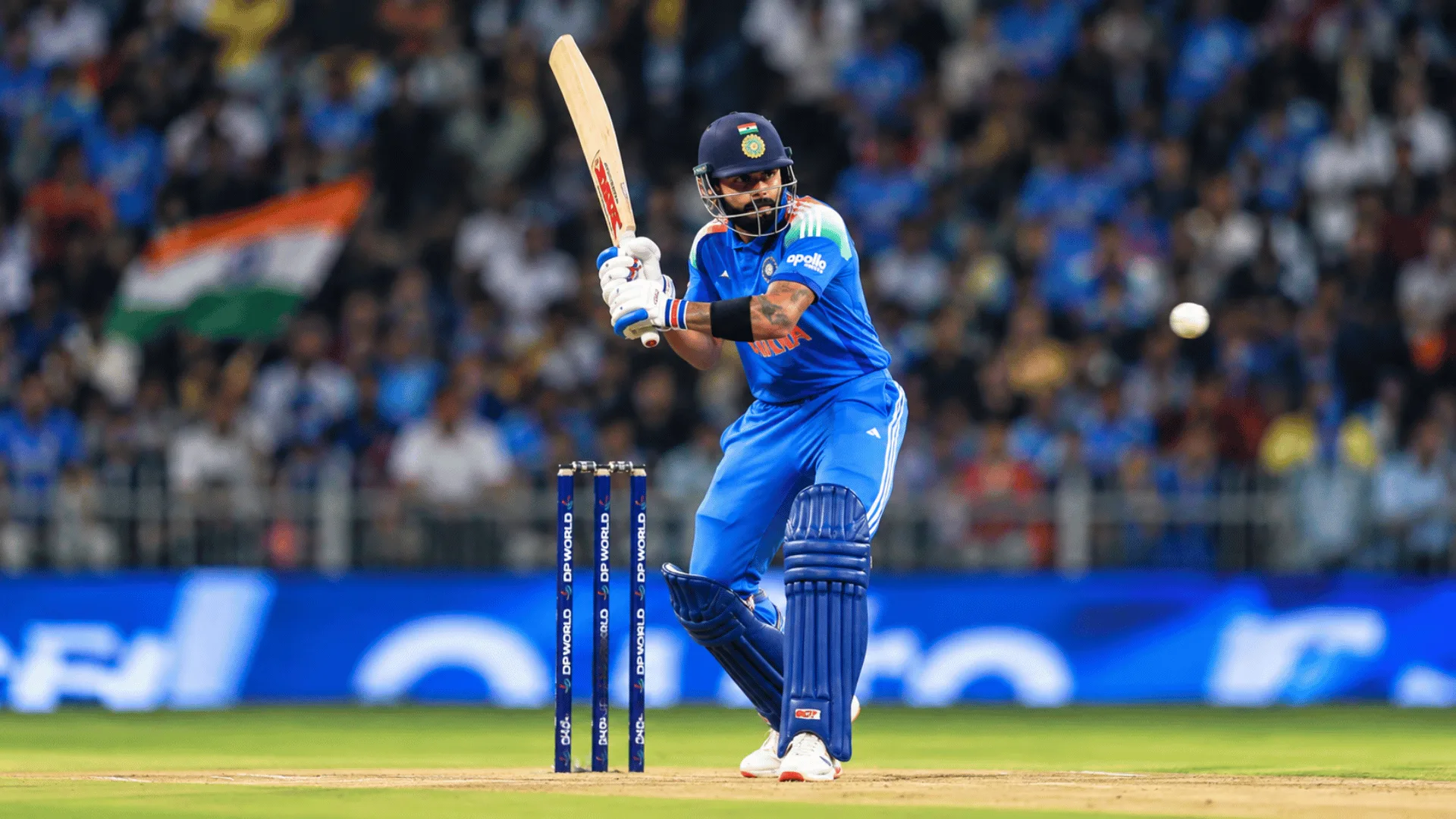
Virat Kohli believes there is still another level to his ODI batting, and his performances over the past year suggest that the former India captain may have found a new way to reach it.
After India's first ODI against West Indies in Thiruvananthapuram, Kohli spoke about his desire to “up the ante” and play at a higher gear. The comment came on a significant night in his career, when he became only the second batter to pass 15,000 ODI runs.
Yet the milestone was not the most revealing part of his performance. Instead, Kohli's willingness to discuss another version of himself highlighted how dramatically his approach has changed since becoming a one-format international player.
The transformation is not about rebuilding his technique. It is about using that technique with greater intent, taking risks earlier and putting more pressure on bowlers from the beginning of his innings.
Kohli’s ODI Career Has Entered a New Phase
Kohli's transition into a one-format career did not initially produce the attacking transformation now visible in his batting.
After retiring from Test cricket in May 2025, he endured consecutive ducks during India's ODI tour of Australia in October. It was the first time in his ODI career that he had been dismissed for zero in successive innings.
The turnaround began during India's home ODI series against South Africa later that year.
Since the start of that series, Kohli has scored 854 runs in 12 innings at a strike rate of 117.63. His unbeaten 139 against West Indies in Thiruvananthapuram was another reminder that his current form is not simply a short-term surge.
His previous 10 innings had produced 825 runs, a sequence that ranks among the most productive 10-innings stretches in ODI history.
Only six other 10-innings sequences have produced more runs, and Kohli himself owns two of the entries above it.
Kohli’s Three Distinct ODI Phases
The change becomes clearer when his ODI career in the 2020s is divided into three periods.
| Period | Innings | Runs | Average | Strike Rate | 100s | 50s |
|---|---|---|---|---|---|---|
| 2021-22 | 14 | 431 | 30.79 | 86.90 | 1 | 4 |
| Oct 2023 - Australia tour | 24 | 1,172 | 61.68 | 87.79 | 4 | 9 |
| Since Nov 2025 | 12 | 854 | 85.40 | 117.63 | 4 | 4 |
The first period represented one of the toughest stretches of Kohli's career. He averaged only 30.79 and struggled against both pace and spin.
The next phase brought back his trademark consistency. From 2023 until the Australia tour, Kohli averaged more than 60, but his strike rate remained below 90.
That period often saw Kohli play the stabilising role in India's batting order. With aggressive players such as Rohit Sharma and Shreyas Iyer capable of attacking spin, Kohli could focus on batting deep and controlling the innings.
That balance appears to have changed.
The Biggest Difference Is His Intent
Since the South Africa series, Kohli has maintained his ability to score heavily while increasing his scoring rate dramatically.
Against pace, his strike rate has risen to 123.54, compared with 94.78 during the 2023-25 period. His average has fallen from 63.60 to 50.90, but that remains an elite return considering the increased tempo.
His improvement against spin is equally significant. Kohli has not been dismissed by spin during this latest phase and is scoring at 109.87, compared with 80.82 between 2023 and 2025.
One of the clearest explanations is his increased boundary frequency.
During 2021-22, Kohli found a boundary once every 10.2 deliveries. Over the most recent 11-month period, that figure has improved to one boundary every 7.3 balls.
His six-hitting has changed even more dramatically.
Kohli struck a six once every 173.5 balls during 2021-22. That improved to one every 133.5 balls during 2023-25, before rising sharply to one every 25 balls in the latest phase.
This does not mean Kohli has abandoned his controlled approach. Instead, he appears to have become more comfortable choosing aggressive options earlier.
Attacking Good-Length Bowling
One of the most interesting changes has come against good-length deliveries.
Between 2023 and 2025, Kohli struck at 79.20 against good-length balls. Since November 2025, that number has climbed to 111.95.
Interestingly, the percentage of good-length deliveries he attacks has barely changed, increasing from 48.4% to 48.6%.
The difference is what happens once he chooses to attack.
His strike rate on those attacking shots has jumped from 121.95 to 168.88.
At the same time, Kohli has become less passive. The percentage of good-length deliveries he defended or left alone fell from 27.9% to only 11%.
Instead of waiting for the bowler to make a mistake, he is increasingly using those deliveries to rotate the strike or create scoring opportunities.
Kohli Is Using His Feet More Often
Another important development is Kohli's increased use of the crease.
During the 2023-25 period, he stepped down the pitch against pace on only 4.2% of deliveries. Since November 2025, that number has more than doubled to 10.1%.
The tactic is not simply about hitting bowlers over the top.
Kohli often comes down the pitch and plays conventional drives, forcing fast bowlers to reconsider their length. His ability to maintain balance while moving forward allows him to attack without completely abandoning his traditional batting method.
The approach has similarities to the aggressive intent he displayed earlier in his career.
During the 2012-13 period, Kohli was more willing to use his feet against pace. In Jaipur in 2013, for example, he used his feet against Australia's fast bowlers repeatedly while producing a remarkable 52-ball century.
The current version appears to be bringing some of that intent back, but with the experience of a batter who has spent nearly two decades at the highest level.
Early Overs Are No Longer About Waiting
Kohli's increased aggression is particularly visible during the opening stages of his innings.
He is striking at 109.48 against pace during his first 20 deliveries, compared with 80 during the 2023-25 phase.
His Powerplay strike rate has also increased sharply, from 75.34 to 110.
His 93 against New Zealand in Vadodara provided one of the clearest examples.
India were chasing 301 when Kohli arrived at 39 for 1 in the ninth over. Rather than spending a long period rebuilding the innings, he immediately attacked, reaching 27 from only 20 deliveries with six boundaries.
He eventually scored 93, helping India complete the chase with an over remaining.
Kohli later explained that when conditions are difficult, he now prefers counterattacking rather than remaining passive and hoping for a better opportunity later.
That mentality may be one of the defining features of his current ODI batting.
Spin Is Also Being Attacked More Aggressively
The change is not restricted to fast bowling.
Against spin, Kohli's percentage of attacking shots has increased from 49.3% to 57%.
His strike rate against spin during his first 20 deliveries has also risen from 80.12 to 103.64.
He is taking more aerial options against spinners as well. The percentage of spin deliveries he hits in the air has increased from only 2.1% during 2023-25 to 10.5%.
His use of his feet against spin has also risen from 0.2% to 6.8%.
Kohli's century against West Indies in Thiruvananthapuram provided a perfect illustration. He reached three figures with a six against Gudakesh Motie after moving down the pitch and attacking the spinner rather than waiting for a conventional scoring opportunity.
Why Has Kohli Found Another Gear?
There may not be one single explanation for Kohli's transformation.
His own comments suggest that his mental approach has changed, with greater confidence in his ability to take risks while maintaining his technique.
There have also been changes around him.
Rohit Sharma is no longer operating with exactly the same Powerplay role he had during India's previous ODI phase, potentially leaving Kohli with greater responsibility to increase the tempo.
The modern ODI environment also rewards early scoring. With batting conditions potentially becoming more difficult later in an innings, creating a strong platform before the ball gets older can be strategically valuable.
But perhaps the most important factor is Kohli's retirement from Test cricket.
For much of his career, he had to maintain a batting method capable of moving between formats. That meant certain attacking tendencies could be restrained when Test cricket was approaching.
That restriction no longer exists.
His IPL experience has also exposed him to a higher tempo of batting and a wider range of aggressive scoring options. The confidence gained from repeatedly executing those shots in T20 cricket appears to be transferring into his ODI game.
The result is not a completely different Kohli.
It is a Kohli who appears more willing to use the skills he already possesses.
The Real Change Is Controlled Aggression
Perhaps the most important point about Kohli's latest evolution is that his aggression has not turned him into a reckless batter.
His technical foundation remains largely intact.
The major difference is when he chooses to attack.
He is more prepared to move down the pitch, take aerial options, attack good-length deliveries and rotate the strike instead of allowing bowlers to settle.
That combination of technique, experience and increased intent makes the current version of Kohli particularly dangerous.
At 37, he is no longer playing to establish himself or prove that he belongs at the highest level.
He is searching for another way to dominate it.
South Africa 2027 Will Provide a Major Test
The next major challenge will come in conditions very different from many of the flat surfaces where this transformation has developed.
The 2027 ODI World Cup in South Africa will provide Kohli with a range of challenges, including potentially helpful conditions for seamers, greater bounce in the Highveld and different surfaces in venues such as Paarl and Centurion.
His improved ability to attack pace could be especially valuable.
The willingness to challenge good-length bowling and use his feet could force fast bowlers away from their preferred lengths. At the same time, his improved approach against spin gives opponents fewer obvious ways to slow him down.
However, Kohli's ability to adapt remains one of the defining characteristics of his career.
He does not necessarily need to maintain the same tempo in every condition.
The real significance of his latest phase is that he now appears to have more options available to him.
A New Version of Virat Kohli
Kohli's recent numbers suggest that this is more than a temporary burst of form.
He is scoring faster, attacking earlier, using his feet more frequently and taking more risks against both pace and spin.
Yet the foundations of his batting remain recognisable.
That may be what makes this phase so fascinating.
After more than 15,000 ODI runs and almost two decades at the international level, Kohli is still finding ways to expand his game.
His next version may not be a completely different batter.
It may simply be the same Virat Kohli, finally playing with fewer restrictions.