
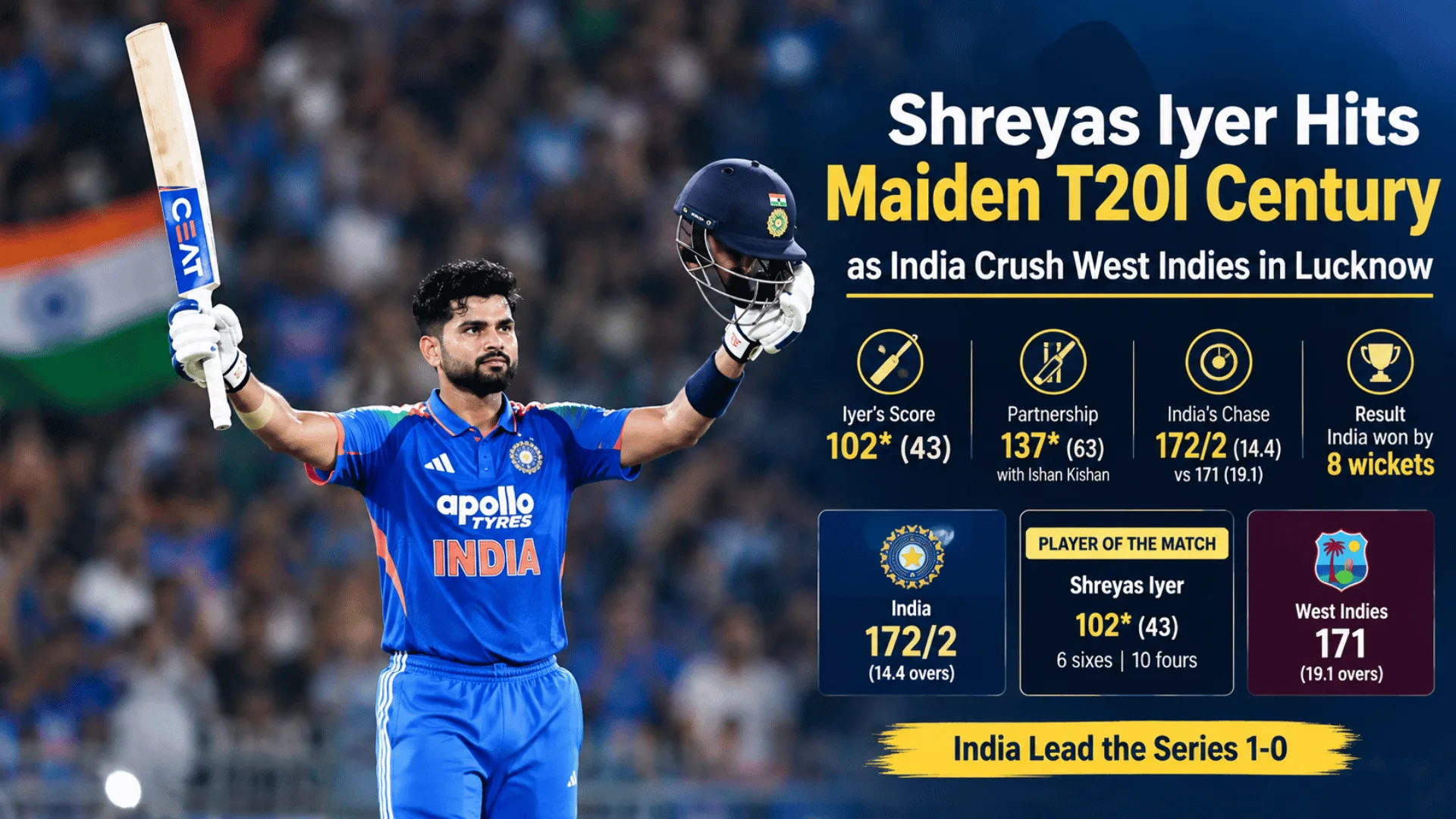
Shreyas Iyer produced a stunning captain's performance as India began their T20I series against West Indies with a dominant eight-wicket victory in Lucknow.
Leading from the front, Iyer smashed his maiden T20I century, scoring an unbeaten 102 from 43 balls as India chased down West Indies' 171 with 32 balls to spare.
His innings featured six sixes and 10 fours and came after India had slipped to 35 for 2 inside the opening four overs. Iyer then joined forces with Ishan Kishan to completely turn the chase around, with the pair putting together an unbeaten 137-run partnership.
The victory also extended India's winning streak in men's T20Is to 10 consecutive matches.
Iyer Rescues India After Early Setbacks
India's chase began positively, but West Indies quickly found a way back into the contest.
Abhishek Sharma attacked from the opening over before Roston Chase dismissed him for 21 from 10 deliveries. Shimron Hetmyer completed the catch to end India's first-wicket partnership.
Sanju Samson followed shortly afterwards, slicing a delivery from Akeal Hosein back towards the bowler. Hosein completed the catch, leaving India at 35 for 2 after 3.3 overs.
That brought Iyer and Kishan together, and the pair immediately focused on rebuilding the innings without allowing the required rate to become a concern.
Iyer finished the Powerplay with four boundaries as India reached 62 for 2 after six overs.
From that point, the captain gradually increased the pressure on the West Indies bowlers.
Iyer Shifts Through the Gears
Iyer reached his half-century from just 28 balls, but that was only the beginning of his acceleration.
An expensive ninth over from Romario Shepherd produced 19 runs, with Iyer doing most of the damage. By the end of the 10th over, India had moved to 102 for 2 and required only another 70 runs.
Iyer then began attacking with even greater freedom.
A six against Shamar Springer marked the start of a spectacular period in his innings. He followed it with further boundaries against Akeal Hosein before destroying Matthew Forde's over with three sixes and a four.
That 24-run over pushed Iyer to 95.
Two deliveries into the following over, Iyer completed the milestone that had been building throughout the chase. He launched Roston Chase over long-on to reach his first T20I century from only 42 balls.
It was the second-fastest T20I century by an Indian captain, behind Rohit Sharma's 35-ball hundred against Sri Lanka in 2017.
Iyer then took a single from the following delivery to complete India's eight-wicket victory.
Ishan Kishan Provides Crucial Support
While Iyer dominated the scoring, Ishan Kishan played an important supporting role.
Kishan remained unbeaten on 37 from 27 balls and shared a remarkable 137-run stand with his captain.
His contribution allowed Iyer to attack without needing to take unnecessary risks at the other end.
The partnership completely changed the match after India's early trouble and ensured the chase remained comfortably ahead of the required rate.
India eventually reached 172 for 2 in only 14.4 overs.
Naman Dhir Makes Dream T20I Debut
India's batting hero was supported by an impressive performance from debutant Naman Dhir with the ball.
The all-rounder claimed 3 for 31 with his off-spin on his first T20I appearance, playing a major role in restricting West Indies to 171.
Dhir's performance became particularly important during the middle overs, when West Indies were attempting to recover after losing several wickets.
He dismissed Romario Shepherd, Shamar Springer and another West Indies batter as India repeatedly disrupted the innings.
His three-wicket haul helped India turn what initially appeared to be a promising West Indies total into a manageable target.
West Indies Make a Fast Start
West Indies were asked to bat first and made an aggressive start through captain Shai Hope and debutant Kamil Pooran.
Hope was particularly dangerous during the second over, attacking Mayank Yadav for four boundaries and quickly moving to 21 from 12 deliveries.
Pooran also showed positive intent before Arshdeep Singh provided India's first breakthrough, bowling the debutant after he had faced 11 balls.
The West Indies then suffered two further setbacks during the Powerplay.
Hetmyer was run out attempting a single before Axar Patel dismissed Rovman Powell with a delivery that crashed into the stumps.
Axar finished the Powerplay with a double-wicket maiden as West Indies slipped to 41 for 3.
Hope and Rutherford Rebuild the Innings
Despite the early collapse, Hope and Sherfane Rutherford began rebuilding the innings.
The pair attacked India's spin options and kept the scoreboard moving through the middle overs.
Kuldeep Yadav was hit for two sixes in the ninth over, while Axar Patel conceded 18 in the 11th as Rutherford increased the pressure.
Hope reached his half-century from 36 balls, continuing his excellent form after his unbeaten 162 in the third ODI against India.
However, the West Indies captain was unable to convert his start into a bigger score.
His dismissal for 52 triggered another collapse.
West Indies Slide From 107 for 3 to 135 for 8
After Hope departed, West Indies struggled to maintain their momentum.
Roston Chase fell after briefly finding the boundary, while Romario Shepherd was dismissed by Dhir after hitting a six.
Ishan Kishan also produced one of the highlights of the innings with an excellent back-handed catch at deep mid-wicket to remove Matthew Forde.
Dhir then claimed his third wicket by having Shamar Springer caught in the deep.
West Indies had fallen from 107 for 3 to 135 for 8, leaving their total in serious danger of falling well below 170.
Rutherford Keeps West Indies Alive
Sherfane Rutherford ultimately provided the late resistance West Indies needed.
The left-hander scored 56 from 34 balls, striking four fours and two sixes.
He found an important partner in Akeal Hosein, who was playing his 100th T20I.
The pair added 36 runs from only 18 deliveries, giving West Indies a chance of reaching a competitive total.
Rutherford eventually fell from the final delivery of the 19th over, while Axar Patel removed Hosein with the first ball of the final over.
West Indies were bowled out for 171 in 19.1 overs.
India's Bowlers Share the Workload
Naman Dhir led India's bowling attack with three wickets, while Kuldeep Yadav claimed two wickets.
Axar Patel also played a significant role during the Powerplay and later completed the final wicket.
Arshdeep Singh provided the opening breakthrough, while India's fielding also contributed at crucial moments.
The combination of early wickets, middle-over pressure and late-innings control ensured West Indies never established enough momentum to make the 171-run total particularly threatening.
Iyer Sets the Tone for India's T20I Campaign
The victory was more than simply a successful start to the series.
Iyer's century offered a glimpse of the attacking approach India want to take in the shortest format.
After the match, the India captain suggested that the team could become one of the most destructive sides in T20I cricket if they continue playing with the same mindset.
His own innings was a perfect example of that philosophy.
India lost two wickets early, but instead of allowing the required rate to build, Iyer immediately rebuilt the innings before launching an explosive attack once the field began to spread.
India Take a 1-0 Series Lead
India's final score of 172 for 2 in 14.4 overs secured an eight-wicket victory with 32 deliveries remaining.
The result extended India's T20I winning streak to 10 matches and gave them an early advantage in the series.
Iyer finished unbeaten on 102, while Kishan remained unbeaten on 37.
For West Indies, Rutherford's 56 and Hope's 52 were the major contributions with the bat, but their middle-order collapse proved decisive.
Match Summary
West Indies: 171 all out in 19.1 oversIndia: 172/2 in 14.4 oversResult: India won by 8 wicketsPlayer of the Match: Shreyas IyerTop scorer: Shreyas Iyer – 102* off 43 ballsBest bowler: Naman Dhir – 3/31
Ranchi Awaits for the Second T20I
The two teams will now move to Ranchi for the second T20I on October 9.
West Indies will need to find a way to contain Iyer after his remarkable century while also preventing India's batting order from establishing another dominant partnership.
India, meanwhile, will look to maintain the aggressive approach that has now produced 10 consecutive T20I victories.
With Iyer already setting the tone in Lucknow, the second match promises another opportunity for India's new-look T20I leadership to build momentum.