
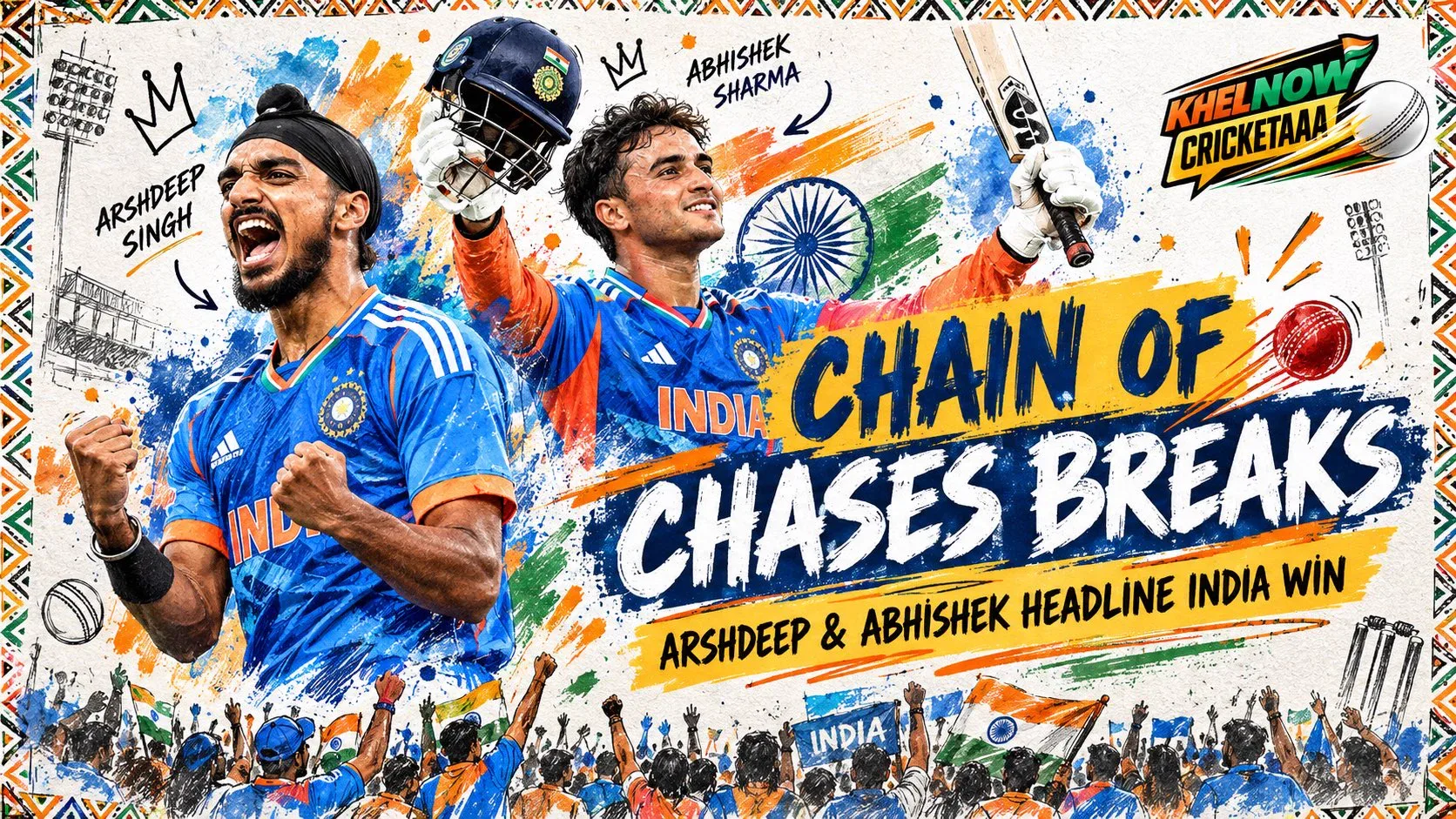
India ended West Indies' winning streak in successful chases on the tour with a hard-fought 14-run victory in the third T20I at the Holkar Stadium in Indore. Powered by Abhishek Sharma's explosive 69 and a decisive bowling performance led by Arshdeep Singh, India defended 223 to take a 2-1 lead in the five-match series.
Abhishek smashed 30 balls for his 69, forming a remarkable 108-run partnership with Ishan Kishan in just 40 deliveries. Although India lost momentum in the middle overs and finished with 223 in 20 overs, their bowlers responded with discipline to restrict West Indies to 209/7.
The result was significant because it marked the first time on the tour that a team had won after batting first. Previous matches had consistently favoured the chasing side, including high-scoring contests in which targets of 406 and 250 had been successfully pursued.
Abhishek Sharma Sets Up India's Big Total
India did not make a particularly fast start. Sanju Samson was dismissed for just three, and the hosts managed only 13 runs from the first 14 balls of their innings.
Abhishek explained after the match that he had initially been cautious against West Indies spinner Roston Chase, who had been bowling effectively throughout the series. He wanted to respect the challenge before looking for opportunities to attack.
That approach quickly paid off. During the third over, Abhishek struck Chase for a boundary and two sixes, changing the momentum of the innings. Ishan Kishan also attacked from the other end, finding boundaries against Keemo Paul.
Abhishek reached his half-century in just 18 balls, helping India finish the Powerplay at 87/1. The 108-run stand between Abhishek and Kishan came at a remarkable scoring rate of 16.2 runs per over, becoming India's fastest century partnership in T20I cricket.
Kishan contributed 37 from only 18 deliveries, complementing Abhishek's aggressive stroke play and giving India the platform for a commanding total.
Abhishek and Kishan Build Their Partnership Through Trust
Speaking after the match, Abhishek highlighted the understanding he shares with Kishan, explaining that their familiarity helps them play with freedom even when a wicket falls early.
He said he tries to keep Kishan relaxed when he arrives at the crease, particularly when the pressure of an early dismissal could affect his approach. Their previous partnerships, including those in the IPL, have helped them understand each other's game.
Rather than focusing excessively on conditions, the pair prefer to enjoy each other's batting and complement one another's strengths.
Their partnership in Indore demonstrated how quickly they can turn a cautious start into a scoring surge, placing the opposition under immediate pressure.
West Indies Turn the Game Around in the Middle Overs
India appeared to be heading towards an even bigger total before Chase produced a crucial spell that disrupted their momentum.
Kishan was stumped after advancing down the pitch, while Shreyas Iyer was dismissed lbw for one later in the same over. Abhishek fell in the following over after mistiming a pull shot, leaving India three wickets down for just nine runs in ten balls.
The slide continued when Naman Dhir was caught at long-off, reducing India to 135/5.
India struggled to build another substantial partnership. Nitish Kumar Reddy scored 21 before being caught behind, while Tilak Varma was run out for 28 after a misunderstanding with Axar Patel. Axar was also run out later in the innings.
Prince Yadav provided a late boost with three boundaries in the final over, helping India reach 223. Despite losing wickets in clusters, the total gave the bowlers a competitive target to defend.
India's Bowlers Break the Chasing Trend
West Indies entered the chase with confidence, especially given the batting-friendly conditions and the short square boundaries at the Holkar Stadium. Captain Shai Hope again elected to bowl after winning the toss, expecting the conditions to favour the chasing side.
However, the dew that had influenced the previous match in Ranchi did not become a major factor in Indore.
India began with six overs of pace, and Mayank Yadav immediately applied pressure by conceding only two runs in the opening over. Arshdeep Singh then delivered a major breakthrough, bowling Hope and disrupting West Indies' plans at the top of the order.
Shimron Hetmyer counterattacked after surviving a dropped catch, scoring 43 from 26 balls. But Naman Dhir removed him soon after being hit for a six, ending a dangerous innings.
West Indies reached 54/1 at the end of the Powerplay, well behind India's 87/1 at the same stage. The difference in starts increased the pressure on the visitors as the required run rate continued to climb.
Kamil Pooran and Sherfane Rutherford Keep West Indies in the Contest
Kamil Pooran initially struggled to find his timing before launching an attack against Dhir in the 11th over. He struck three sixes and appeared ready to shift the momentum back towards West Indies.
However, Pooran attempted another big shot and picked out Arshdeep in the deep, departing for 42. His dismissal left the visitors needing a significant contribution from the middle and lower order.
Sherfane Rutherford, who had caused India problems in Ranchi, tried to keep the chase alive alongside Quentin Sampson. The pair added 46 runs, but the required rate continued to rise.
Nitish dismissed Sampson, leaving West Indies needing 65 runs from the final four overs. The match was still not completely settled, given the visitors' ability to score rapidly, but India were beginning to gain control.
Arshdeep Singh Delivers the Decisive Over
Arshdeep returned at a crucial moment and effectively sealed the contest by dismissing Keemo Paul and Rutherford in the same over.
The double strike removed two important threats and left West Indies with too much to do in the final six balls.
Shamar Springer continued attacking and hit Axar Patel for three sixes in the final over. However, West Indies needed 37 runs from those six deliveries, making the target virtually unreachable.
The visitors finished on 209/7, falling 14 runs short of India's total.
Arshdeep ended with figures of 3/44, while Dhir claimed two wickets for 39 runs. Their contributions ensured that India's aggressive batting performance was supported by a disciplined bowling display.
Abhishek Calls for a Ruthless Approach
After the victory, Abhishek stressed that India had discussed the importance of remaining ruthless during their team huddle.
He warned that West Indies could turn a match around even when they appeared to be well behind, pointing to the visitors' attacking batting style and Springer's late hitting as examples.
Abhishek said India wanted to avoid giving their opponents any opportunity to recover. Even when West Indies were under pressure, the Indian bowlers had to remain alert, execute their plans and avoid delivering loose balls.
His comments reflected a key lesson from the previous match: a strong start with the ball is not enough against a side capable of producing quick runs throughout the batting order.
India's bowlers largely followed that approach in Indore, maintaining pressure during important phases and taking wickets when West Indies threatened to accelerate.
India Take a 2-1 Lead in the T20I Series
The 14-run victory gives India a 2-1 advantage in the five-match T20I series and provides an important boost after a run of matches dominated by successful chases.
Abhishek's explosive half-century and his partnership with Kishan established the foundation, while Arshdeep's decisive spell and Dhir's two wickets helped India defend the total.
The match also highlighted the balance India need to maintain: aggressive batting can create a formidable target, but disciplined bowling is essential to prevent West Indies from mounting a comeback.
With the series still to be decided, India will look to carry the confidence from Indore into the remaining matches. West Indies, meanwhile, will need to find ways to respond to India's improved bowling execution.
For India, the biggest takeaway may be Abhishek's message: against a dangerous West Indies batting lineup, no lead is safe until the final ball is bowled.